What is Nuclear Medicine
Nuclear Medicine is a medical specialty for diagnosis and treatment of serious diseases. As an integrated part of patient care, nuclear medicine is used to studies document organ, function and structure, in contrast to conventional radiology, which create images based upon anatomy. Many of the nuclear medicine studies can measure the degree of function present in an organ, provide important information that allows the physician to detect and treat a disease early. It is nuclear medicine that used the best to study the function of a damaged heart or restriction of blood flow to parts of the brain. The kidneys, liver, thyroid gland, bones and other organ are similarly imaged.
Nuclear Medicine imaging procedures often identify abnormalities very early in the progression of disease long before some medical problems are apparent with other diagnostic tests.
The Technologist’s Role
The Nuclear Medicine Technologist is highly specialized healthcare professional who works closely with Nuclear Medicine Physician. The responsibilities are to:
During the imaging procedures, the technologist works directly with the patient. The technologist:
Nuclear Medicine will continue to be a field at the forefront of modern clinical medicine and technological development. The future of Nuclear Medicine is bright, thanks to –
Career Opportunities
Nuclear Medicine Technologists work in a wide variety of clinical setting such as general and community hospitals, university-affiliated teaching hospitals and Medical Centers, outpatient imaging facilities, clinics, public health institutions, and government and private research institutes.
Program Description
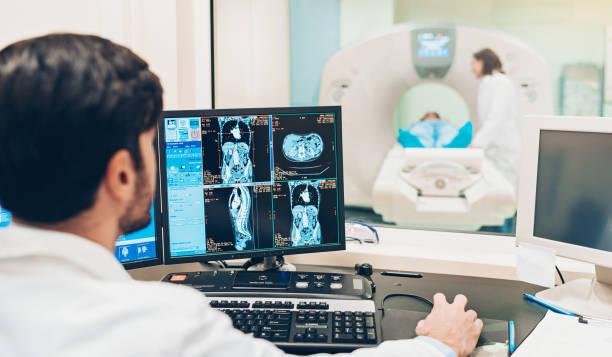
The Nuclear Medicine technology at the St.George University is an 18-month full time program leading to certification in nuclear medicine technology. The integrated curriculum is structured to provide academic training in the principles of medical imaging and practical hands-on clinical experience. The program is designed to develop technical knowledge, critical thinking skills, promote professional ethics. The students are provided with training on state-of-art equipment and will gain competency in routine diagnostic examination, SPECT and PET imaging, radiopharmacy, in-vitro procedures, and therapeutic applications.
Program Goals and Objectives
Curriculum
The curriculum is designed to provide the student with a comprehensive body of knowledge and the necessary skills expected of a competent graduate. The curriculum provides skills for a lifetime of continued learning, rewarding careers and to become leaders in the nuclear medicine community.
The curriculum include academic (didactic) instructions that provides learning experiences to help better understand and perform clinical responsibilities, laboratory studies and clinical practicum:
The curriculum include academic (didactic) instructions that provides learning experiences to help better understand and perform clinical responsibilities, laboratory studies and clinical practicum:
Supervised Clinical Education – very important aspect of the curriculum, and offers a sufficient n well-balanced variety of nuclear medicine procedures, examination and equipment.
ADMISSION
Admission Requirements
The following explains the requirement an applicant must meet to be considered for admission: